
Wokingham entries hit 31.8% at A* or A against 28.3% nationally, but only 0.3 points above the South East. Holt, Piggott and Blue Coat figures in full.
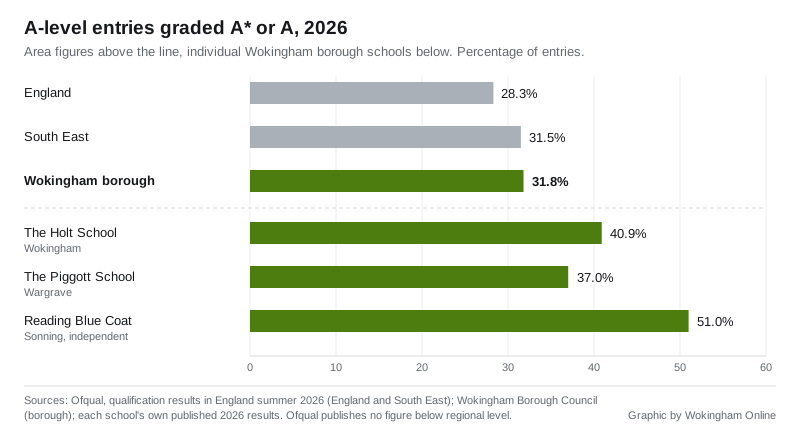
Nearly a third of A-level entries sat in Wokingham borough were graded A* or A this summer, on figures the council published on results day. Around 1,098 students took 3,130 A-levels between them, and 994 of those entries, 31.8 per cent, were awarded one of the top two grades (Wokingham Borough Council).
The council’s comparison was with the national average of 28.3 per cent, which checks out. Set the borough against its own region instead and the gap almost disappears. Ofqual’s official statistics put the South East on 31.5 per cent of A-level results at grade A and above, and on 79.5 per cent at grade C and above (Ofqual, qualification results in England, summer 2026). Wokingham’s equivalents are 31.8 per cent and 79.8 per cent. The borough is a fraction ahead of the South East, not clear of it.
That is a normal result for this part of Berkshire rather than a disappointing one. The South East is the second strongest region in England for top grades, behind London on 32.7 per cent, and every borough in it is measured against a high bar.
How the figures were worked out
One point is worth being precise about, because the council’s own write-up puts it two different ways. The 31.8 per cent is a share of entries, not of students: 994 top grades out of 3,130 A-levels sat. That matters because it is the same basis Ofqual uses, so the two are directly comparable.
Ofqual’s tables do not publish results below regional level, so there is no official Wokingham figure to check the council’s against. The regulator has no England row in its regional table either; weighting its nine regions by the number of results gives 28.3 per cent at A and above and 78.1 per cent at C and above, matching the comparators the council used. Nationally, 835,950 A-level results went to 320,505 students at 2,835 schools and colleges.
The council also reported 58.9 per cent of borough entries at A* to B against 55.6 per cent nationally, and 96.4 per cent at A* to E. We could not verify either against Ofqual, whose published tables carry only A and above and C and above.
The schools that have published their own figures
Three schools in the borough had put 2026 A-level results on their own websites by Friday. Their numbers are not a league table, because different sixth forms teach very different cohorts, but they are first hand.
The Holt School, Wokingham, entered 135 candidates. It reports a 99.5 per cent pass rate, 14.0 per cent of grades at A*, 40.9 per cent at A* or A, 71.3 per cent at A* to B and 88.5 per cent at A* to C, with an average point score per entry equivalent to a B+ (The Holt School).
The Piggott School at Wargrave entered more than 240 students and reports a 99 per cent A-level pass rate, 12 per cent of results at A*, 37 per cent at A* to A, 68 per cent at A* to B and 87 per cent at A* to C, with an average of 40 points per entry, a grade B. Its vocational results are reported separately: a 100 per cent pass rate on Applied General qualifications with 86 per cent at Distinction* to Merit, and every student entered for a Technical qualification achieving a merit or higher (The Piggott School).
Reading Blue Coat School at Sonning, an independent school in the borough, reports 51 per cent of 2026 A-level grades at A* to A, 80 per cent at A* to B and 19 per cent at A*, with five students taking a full set of A*s and more than 85 per cent of leavers securing their first-choice university (Reading Blue Coat School). Sonning is a civil parish within Wokingham borough (Sonning Parish Council).
Several other borough sixth forms had not published 2026 figures as of Friday 15 August. The Emmbrook School, Waingels College and Luckley House School all still showed 2025 results on their exam results pages, and Maiden Erlegh School marked the day with a message of congratulation rather than numbers.
Reading a school’s percentages fairly
Comparing any single school with a national average needs one caution. Schools usually publish A*-B, A*-C or A*-E, sometimes including vocational equivalents, while Ofqual reports A and above and C and above for A-levels alone. A*-C against C and above is roughly like for like. A*-B has no national counterpart in Ofqual’s published tables at all, so a school’s A*-B figure can only sensibly be set against its own previous years.
The fairer benchmark is Ofqual’s breakdown by centre type, which shows how much a school’s intake shapes the result. In 2026, 23.5 per cent of A-level results at academies were A or above, and 25.4 per cent across all state-funded centres, against 43.4 per cent at grammar schools and 48.6 per cent at independent schools. On grade C and above the figures were 75.8 per cent for academies, 76.8 per cent across all state-funded centres, 88.4 per cent at grammars and 89.4 per cent at independents.
Read that way, the two state schools above are performing well ahead of the centre types they belong to, and Reading Blue Coat’s 51 per cent sits a little above the independent-sector average of 48.6 per cent.
What it means for you
If your result was not what you needed, the appeal route is time limited and it runs through your school or college, not through you. For internal candidates, requests must be submitted by an authorised member of centre staff, and you have to give written consent before the centre can act (JCQ post-results services).
Three deadlines matter this summer:
- Priority review of marking: 20 August. For A-level, T Level and Level 3 vocational results where a university place depends on the outcome. Completed within 15 calendar days of the awarding body receiving the request.
- Review of marking: 24 September. Completed within 20 calendar days.
- Clerical re-check: 24 September. A check that marks were added and recorded correctly, completed within 10 calendar days.
Be clear about the risk before you ask. JCQ requires that candidates “must be informed that their marks and subject grades could go down as well as up”, and if a mark or grade is reduced after a review, the request cannot be withdrawn and the original will not be reinstated.
T Level, apprenticeship and other post-GCSE vocational results were issued on the same day as A-levels, and BTEC students collected theirs in the days and weeks before. GCSE results follow on Thursday 20 August, the date Ofqual has said it will update the same statistical release “to include results issued for level 1/2 and level 2 qualifications”.
Wokingham Borough Council publishes guidance on post-16 options and support for young people, and Cllr Prue Bray, executive member for children’s services, pointed families towards it: “If you haven’t achieved the grades you were hoping for, remember that there are many routes to success and plenty of support is available.”
Our other coverage of the borough is on the Wokingham news page, and if these results are part of a decision about where to live, our Wokingham house prices page tracks what the market is doing.
Have your say