
Inspectors have told Wokingham to delete its valued landscapes policy, raise the affordable housing threshold from 5 homes to 10 and delay Loddon Valley.
The two planning inspectors examining the Wokingham Local Plan Update have ordered the council to delete its proposed protection for the borough’s “valued landscapes”, scrap two policies designed to hold back speculative housing, and raise the site size at which developers must provide affordable homes from five dwellings to ten.
Those instructions are in the inspectors’ post hearings letter, sent to the council’s head of planning policy on 4 August and published on the examination website (Inspectors’ post hearings letter, 4 August 2026; Wokingham Local Plan Update examination). Wokingham Borough Council announced the letter on 11 August under the headline that the plan is “on track for adoption”, and reported the inspectors’ conclusion that no extra housing sites are needed (Wokingham Borough Council). Both of those things are true. The letter also runs to eight pages of changes the council must make first, and those are what will show up in planning decisions.
Inspectors Thomas Hatfield and Mark Philpott write that the plan is “likely to be capable of being found sound and legally compliant subject to main modifications”, and that this conclusion still depends on the outcome of Sustainability Appraisal, Habitats Regulations Assessment and a formal public consultation yet to be held.
The valued landscapes designation goes
The plan proposed to formally designate valued landscapes across the borough through Policy NE6, with the areas mapped at Appendix I. The inspectors have found that designation “is not justified” and say the policy and the map “should therefore be deleted from the Plan”. They add that no further hearings on individual valued landscapes or their boundaries are needed.
Their reasoning is about the evidence rather than the landscapes themselves. The letter accepts that valued landscapes exist across the borough and that they have mattered in planning decisions and appeals. What it rejects is the council’s Valued Landscapes Assessment, which the inspectors say fails to justify how each area was identified and how far it extends. They list a lack of clear rationale for how physical attributes were selected and scored in the assessment’s “hotspot” mapping, for taking only the highest scoring 25 per cent of landscapes forward for detailed appraisal, and for how factors outside the hotspot mapping were weighed.
Two policies aimed at speculative development deleted
Policies SS3 and SS4 both dealt with what happens when the council cannot demonstrate a five year supply of deliverable housing sites, the situation in which national policy tilts decisions in favour of granting permission. The inspectors have found both unsound and say both should be deleted, because they “effectively seek to modify the application of national policy” in those circumstances and are inconsistent with it.
Part 1 of Policy SS4 also carried an implied cap of nine dwellings, which the inspectors say is not justified. One element survives: Part 2(b) of SS4 should be modified and added to the list of exceptions in Policy SS5.
Affordable homes on smaller sites
Policy H3 currently requires affordable housing on developments of five dwellings or more. The inspectors say that threshold “is inconsistent with national policy”, that they are not persuaded local circumstances justify departing from it, and that the policy “should therefore reflect the national threshold of 10 dwellings”.
The headline rate is untouched. Council leader Cllr Stephen Conway said the plan “will make sure 40% of homes on major developments are affordable homes”, and nothing in the letter changes that figure. What changes is which schemes have to contribute at all: developments of five to nine homes would no longer be caught. The inspectors also want the supporting text at paragraph 9.31 to drop its reference to Gypsy and Traveller accommodation and care homes, and Part 2 of the policy to lose the tests of “exceptional circumstances” and “compelling reasons”.
Homes arriving later than the council assumed
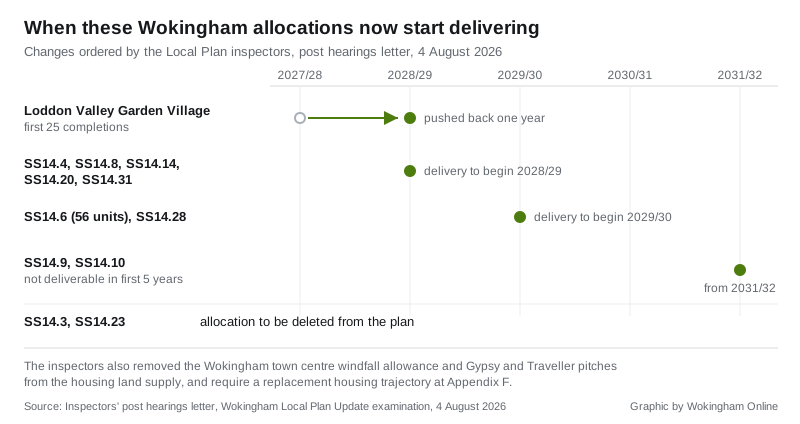
The inspectors call the council’s housing land supply assumptions “broadly robust and justified”, then set out a series of adjustments that all push supply later or take it out altogether.
The windfall allowance for Wokingham town centre is to be removed, because the letter finds no compelling evidence for the assumed uplift compared with what the town centre has actually delivered. Gypsy and Traveller pitches are to come out of the housing land supply, as they sit under a separate policy context with their own five year requirement.
At the Loddon Valley Garden Village strategic development location, the inspectors consider it “unduly optimistic” to assume homes will be delivered in 2027/28, and have pushed the first 25 completions back a year to 2028/29. Within Policy SS14, allocation SS14.3 is to be deleted after the landowner confirmed the site is neither available nor deliverable for Gypsy and Traveller pitches, and SS14.23 is to be deleted because the site is no longer available following a change of ownership, with a business now trading there. Sites SS14.9 and SS14.10 have not been shown to be deliverable in the first five years and may instead count from 2031/32. SS14.21 has outline permission for up to 234 dwellings and the policy is to say so.
Five more allocations, SS14.4, SS14.8, SS14.14, SS14.20 and SS14.31, are to start delivering in 2028/29. SS14.6, in relation to the 56 units granted outline permission in October 2025, and SS14.28 are to start in 2029/30. A replacement housing trajectory has to be prepared for Appendix F.
Despite all of that, the inspectors state they are satisfied “it is not necessary to allocate any further sites for housing in the Plan for it to be sound”, and will explain why in their final report.
The other changes
The letter names more than a dozen further policies, and warns that additional detailed wording changes will follow separately through the Programme Officer.
- Loddon Valley school and boundaries. Policy SS13’s requirement to reserve land so a proposed secondary school could expand to 12 forms of entry is not justified and should be deleted; the inspectors say the garden village will not generate a need for a school that size. They also want the whole site allocated without internal settlement boundaries, with the agreed Strategic Design Code identifying where development goes. This does not apply to the Arborfield Green or South Wokingham SDLs, whose boundaries are largely set by existing features.
- Custom build. The requirement for each strategic development location to provide custom build housing on site, in Policies SS11 to SS13, is unsound and should be deleted: the latest evidence shows significantly lower need than expected, capable of being met by windfalls. Concept plans in the supporting text are to be described as indicative only.
- Employment land. Policy SS8 must specify an employment requirement, using the figures from paragraph 27 of the council’s Stage 2 Matter 2 hearing statement as a minimum, and be modified to acknowledge scope for higher industrial growth. Policy ER2’s “must demonstrate” test is called “overly negative and inflexible” and should become “supported where”.
- Carbon and demolition. Policy CE4 is to be deleted as neither effective nor justified. Part 3 of Policy CE2 and Part 3 of Policy CE3 also go, because there would be no sanction for exceeding the limits. Part 3 of Policy CE5, which restricted demolition, is to be deleted: demolition is permitted development in most cases, so the policy could perversely encourage owners to knock buildings down first, and would inhibit the windfall delivery the council’s own supply figures rely on.
- Older people’s housing and open space. Part 6 of Policy H1 is to be deleted. The open space standards in Part 4 of Policy HC4, carried over from 2012 studies, are found to rest on dated evidence and should become “a flexible starting point” rather than a strict requirement.
- Local Green Space. One designation is trimmed. At LGS029, Land South of River Thames, the area west of the Wokingham Waterside Centre is to be removed, the inspectors finding it tenuously connected to the rest of the space and of limited value in its own right.
The council leader’s other claims hold up against the letter. The requirements for higher energy efficiency in new homes survive as modified policies rather than deletions, and of the borough’s proposed Local Green Spaces only the extent of LGS029 is changed.
What it means for you
If you objected to a specific housing allocation, the letter is the clearest signal yet of where that argument stands, and the numbered site references above are the ones to search for in your parish. Nothing in it is final: the inspectors state their views “could alter following consultation”, and they are not inviting comments from participants at this stage.
If you are watching a small site near you, the affordable housing change is the one to note. Once the plan is adopted with these modifications, a scheme of five to nine homes will not have to provide affordable housing where it would have done under the submitted plan.
If you were counting on the plan to slow speculative applications, the deletion of Policies SS3 and SS4 matters. Those were the council’s attempt to write its own rules for periods when it cannot show a five year housing supply, and the inspectors have removed them as inconsistent with national policy.
The single date to diarise is the main modifications consultation. That is the only formal opportunity left to comment before the inspectors write their final report, and the council says it will be held later this year.
What happens next
The council now has to prepare a consolidated draft of every potential main modification, as tracked changes to the submitted plan in Word, with a separate document for each chapter, submitted through the Programme Officer. The inspectors will comment and work with the council on a final version. The modifications are then set out in a schedule and go to public consultation, alongside a separate schedule of additional modifications that do not affect soundness. Updated evidence, including a revision to document WBC27, is to be published at the same time.
Only after that consultation closes will the inspectors write their final report, taking account of the responses. Their report will also explain why the parts of the plan they are not modifying are sound.
We will publish the consultation dates when the council sets them. Our running coverage of applications and decisions in the borough is on our Wokingham planning news page, and what the market is doing is on our Wokingham house prices page.
Have your say