
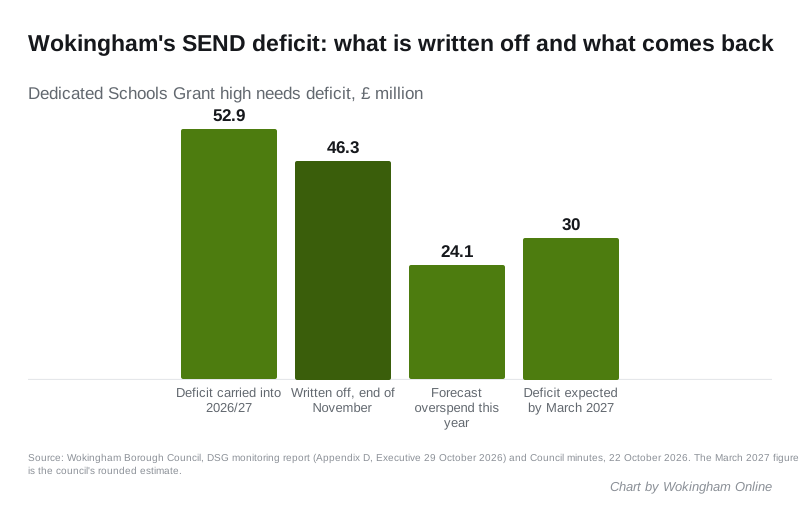
£46.3m of Wokingham's SEND deficit is written off at the end of November, after its reform plan was approved. It is forecast to be back near £30m by March.
The government will write off £46,319,854 of Wokingham Borough Council’s special educational needs deficit at the end of November. The money clears roughly 90% of the debt the council’s schools budget had built up by the end of March.
Councillor Prue Bray, the executive member for children’s services, told full council on 22 October that the borough’s SEND Reform Plan had been approved. The write-off follows from that approval. The draft minutes of the meeting were published on 2 November (Council minutes, 22 October 2026).
She called the approval “a tremendous relief”. She also warned that the relief is partial.
Why the debt comes straight back
The deficit sits in the Dedicated Schools Grant, the ring-fenced government money for schools. Its high needs block pays for support for children and young people with special educational needs and disabilities, and it is where the overspending happens.
- The deficit carried into this year was £52.9 million.
- About £6 million of it will remain after the write-off, Cllr Bray said.
- This year’s high needs overspend is forecast at £24.1 million.
- That puts the deficit back at about £30 million by the end of March 2027.
The £52.9 million and £24.1 million figures are in the council’s latest monitoring report, which went to the Executive on 29 October (revenue monitoring report, quarter two). Its schools appendix blames the overspend mainly on more children being placed in independent and non-maintained special schools, where places cost much more, because the council’s own special schools are short of places (DSG monitoring report, Appendix D).
What happens after March
Nobody yet knows what happens to the new deficit. Cllr Bray told councillors that the government’s letter says the council “should assume the Government will take appropriate action”, without saying what that means.
“We have no definite indication as to what that means,” she said. “So, the situation is slightly better than it was, but in common with most councils with responsibility for Children’s Services, we are still looking at a very considerable problem.”
The quarter two monitoring report gives the same picture. The new High Needs Stability Grant covers up to 90% of deficits built up to 2025/26. Deficits built up after that, to March 2028, will be funded up to an “appropriate amount” that the government has not set.
The rest of the council’s budget
The write-off lands in a hard year. The same Executive papers forecast a £2.5 million overspend on the council’s day-to-day budget, mostly in adult social care, and a loss of more than £43 million in government funding over three years under the Fair Funding Review. Our report on the overspend has the detail.
What it means for you
- If your child has an EHCP or is waiting for one, the write-off changes nothing about their entitlement. The council’s legal duties to assess and provide support are the same.
- The pressure that caused the deficit has not gone. It is the cost of placements outside the borough. The council’s answer is more local specialist places, set out in its £40 million plan for SEND places in the borough.
- For council taxpayers, the write-off takes most of a £52.9 million debt off the books. It does not add money to this year’s budget, which still faces the gaps above.
Cllr Bray also told the meeting that the Children’s Commissioner’s Childhood Lottery report, published on 19 October, ranks Wokingham Borough joint ninth of 153 council areas for children’s experience of growing up, the highest in the Thames Valley.
Have your say